Thursday, November 30, 2006

15 tips to choose a good text type

Many people have asked me which text type is best for a magazine, a newspaper, a poster, a newsletter, a publication, etc. In general, I tell them which to use, but I know that this is not the best answer, because they won't learn to do this by themselves.
Today, I want to take time to analyze how to choose correct text typography design in different cases. It is very important to understand that these tips are not final word, but they can be good help at the moment of choosing a text type. In any case, it depends on what do you want to convey with this type, because many times legibility is as important as the character of the type. Try to be very careful and take in account the following points:
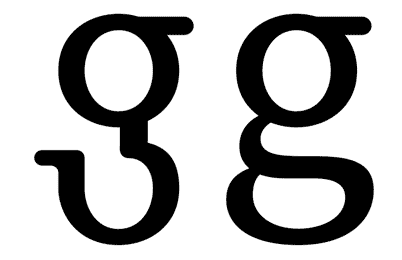


1. The Letterform
The ‘ductus’ represents the framework of a type. It is very important. For legible text we need typographies with a simple ductus without complex details. Those details distract from the reading process and we need the reader to pay attention to the content and not the text.
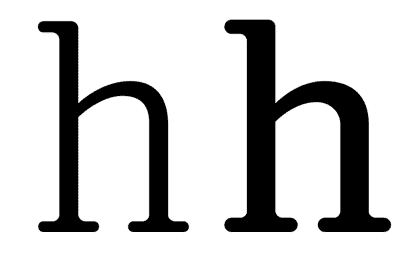


2. The Weight
When we discuss the ‘weight’ of a type, we refer to a consistent relationship between the characters themselves, and the light of the page that flows around them. If you use a light version of a type for a lot of text, reading of this text will probably become tiring and nobody will want to read it.
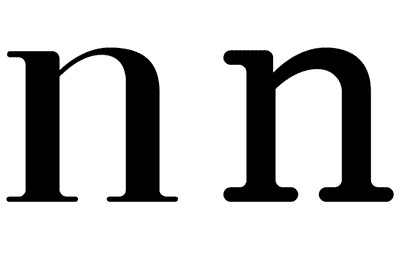


3. The Contrast
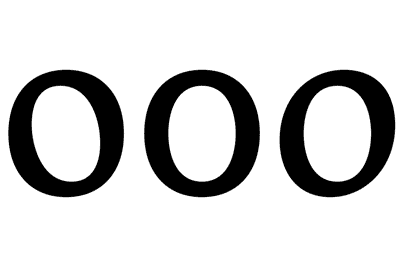
The contrast refers to the thickness difference between vertical and horizontal strokes. The difference between the thicker and the thinner part of the character. Bodoni and Didot are very contrasted type designs. Try to read the photocopy of a photocopy of a photocopy of text layed out in Bodoni. You will probably see only vertical strokes. Good type design should be able to resist a lot of copies. It must be strong, solid, but not coarse.


4. The axis
In my view, the axis of a type design could affect reading. Vertical strokes prevail in a text type and if the axis is diagonal, the eye will have trouble following that line of text. If the type uses more than one axis, a line of text will appear as if dancing which makes is harder to read. If we use an orthogonal axis, the characters can't dance.


5. x height
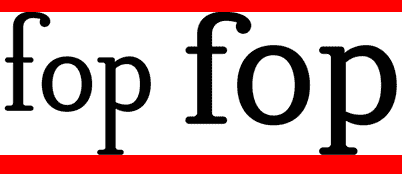
The area between baseline and x height contains most of the readable information (75% of the lower case letters). It is a very important area at the moment of reading text. Long ascenders and descenders require a small x hight. If we compare two types of designs, one with long ascenders and the other with short ascenders, we can see that the x height of the second one will be larger, so it will obviously be more legible. Look up for the difference between Times New Roman and Mrs. Eaves.


6. Capital letters height
Older typefaces designs consider the same height for the ascenders and the capital letters. In any cases capitals are bigger… But the appearance of a word in upper case between lower caps is usually ugly. When I write the word ‘Garamond’ I feel the ‘G’ as a dinosaur and the ‘a’ as its prey…


7. Endings and details
When we use a font in a big size (for example in a poster), we enlarge everything. All the small details of the type design become evident, as well as the mistakes. A lot of typographies are badly drawn. As designers, we should not accept this.


8. Text and texture
A block of text looks like a texture from a distance. This texture must be uniform, without thicker characters or spots that could attract the attention.


9. Degree of the Counter Opening
In many type designs, the counters are too closed. It could cause legibility problems, because somebody could read 'o' instead of an 'c'. So, if the internal counter is too opened (as in Frutiger), it will start to mingle with the external counter, generating a lot of white (and it looks ugly).


10. The Fish Effect
This effect becomes evident when the internal counter is bigger than the space between characters. It looks very strange where round and straight characters join.


11. External counter
There are small details that make a text type design more legible. A carefully designed external counter leads to better text understanding. Think about the connection between the vertical stroke of the ‘n’ and its curve, or the difference between ‘rn’ and ‘m’.


12. Internal counter
A small eye in an ‘a’ or an ‘e’ character will probably disappear, especially in small type sizes. These are the most used characters in most of the languages, that is why this becomes a very big problem.


13. Is the set complete?
How many times do we note that the font we are using lacks a character? It always happens when our design is almost finished. Terrible! We must change the type and check out the complete text again. Many type designers don't design some characters such as ñ, written accents, tildes, points, commas or numbers… It is better to check the font out before using it.


14. The family
It is important to verify that the type family is plentiful, with variations in weight, black, whites and italics… Check out that the italic is as legible as the regular version. Sometimes they have a lot of rococo details.


15. Letter spacing
There are fonts with bad or non-existent letter spacing and obviously, they don't work well. A good designer will try to correct the letter spacing that he (she) considers bad, but it is too much work when all the spacing looks bad… There are software packages that can help, but it is not the same as good typographer work. Try to use fonts with correct letter spacing and metrics…


69 Comments:

Anonymous Fabio Ares said...

Excelente blog al igual que Letritas. Ya lo estoy recomendando a amigos y alumnos. Te cuento que empece con un blog:

http://fabioares.blogspot.com/

No soy un especialista en web pero tengo muchos años de gráfico y quería participar.

Te mando un saludo desde BA.

3:11 AM  
Anonymous Anonymous said...

Ok, what about learning English properly and for e.g. using with instead of "whit"...

7:26 AM  
Anonymous Ramon Bispo said...

Muito bom!!

8:03 AM  
Anonymous Tom said...

I really enjoyed how you analyzed the typeface and pointed out systematic approaches to finding a pleasant typeface.

Another consideration that must be taken into account is the proper usage of faces when setting a longs blocks of type. Choosing the proper size and leading and line length are also very important and vary depending on the face. One could very easily choose a pleasant looking typeface but use it in a very unpleasing way.

However, I must agree with you that often times people select some very poor typefaces to use.

2:07 PM  
Blogger Julián Rodriguez Orihuela said...

You forgot to translate #11.
And what the anonymous user said (a little harshly) about the use of "with" could improve legibility.

Saludos y Feliz año.

10:16 PM  
Anonymous Anonymous said...

"Ok, what about learning English properly and for e.g. using with instead of "whit"..."

E.g means for example. You've basically said "and for for example using with..."

Why not give the guy a break, he you don't have to read the tutorial. Try learning English yourself too.

10:49 PM  
Blogger Kyle Goetz said...

The first anonymous needs to shut up, for he does not use "e.g." properly, so he does not use English properly.

Happy new year, and I really enjoyed reading your blog entry about font stuff. I work on websites for the university I attend, and always enjoy reading about typography.

1:42 AM  
Blogger Googe said...

Thank you so much for this article.

I'm in a bind because I can't yet come up with the best set of types and sizes. People say they like it, but I'm never satisfied in that regard.

Phil
http://www.indierockcafe.com

1:47 AM  
Anonymous Vitaly Friedman said...

Very nice article, indeed! Thanks.

2:25 AM  
Blogger Boney King said...

Very nice. I'll try to remember some of this so i can use later =D

4:56 AM  
Anonymous Anonymous said...

Fabulous article! Great for both those who have studied typography and those who never even knew it existed. Bookmarked!!

5:54 AM  
Anonymous Anonymous said...

What a well laid out self explanatory graphic article that hits the points right away.
www.glendalegolfs.com

6:01 AM  
Blogger geokker said...

Fascinating article, I won't look at typefaces in quite the same way again!

8:48 AM  
Anonymous Trank said...

I'd love to see this whole article on eioba.com

8:53 AM  
Anonymous Alan said...

You could change "tiredness" to "tiring".

I loved and learned from your article.

10:06 AM  
Anonymous Anonymous said...

There is an important element missing.

If you are selecting a typeface for the text portion of a web page, you must be aware of two key elements: (1) many browsers allow the user to tinker with the font size; (2)it is the user, not the web designer, who chooses the screen resolution.

Therefore, you need a typeface which will not only cover up your own mistakes, but your readers' as well! A good test is to take your short list and shrink them all down as small as you reasonably can to see which of the typefaces can withstand the most compression and retain perfect legibility.

Or, you can skip all the verbosity and just use Verdana.

12:15 PM  
Anonymous Piter said...

Thanks a lot! This post is really good. Please, keep up the good work.

4:32 PM  
Anonymous Bliss said...

Thanks a lot. It really helps. A good, thorough artcile. I appreciate your efforts and time for the useful article. Very rare we see a 'complete' information like this.

11:02 PM  
Anonymous Anonymous said...

Wonderful, thanks for taking the time to write this.

Now, for those ignorants who are bitching about "proper english", how about you narrow minded losers try to learn a second language? There is plenty of people here that is able to read this article in both languages without a problem. I guess that makes YOU the dumb ones.

5:53 AM  
Anonymous Anonymous said...

thank you!

7:56 AM  
Blogger Arun said...

Very helpful indeed!
Thanx a ton!

8:36 AM  
Anonymous Jim In The Netherlands said...

I agree with many of the posts here - it's an excellent review of the typographic basics; perhaps something we all need to remind ourselves with occasionally.

Also, as someone struggling with a second language, I cannot believe how narrow-minded and petty some people are concerning typos. Anonymity sure seems to make heros of them all (in their minds, that is). Isn't this another example of "shooting the messenger" and ignoring the message?

Please — let's be gracious with each other!

10:29 AM  
Anonymous Randy J. Hunt said...

This is the kind of explanation I can share with my parents...and they'll understand.

10:48 AM  
Blogger francisca reyes said...

Hi everybody!

I just wanna thank you for all of your comments. Sorry about the 'whit' issue, was a terrible mistake. But we appreciate your corrections, this is exactly what we want. Just as we told you in the first post of typies:

'But we want to ask for your help too… please tell us if you find a mistake (we are sure that you will find a lot)… it is very important for us… We are doing our best effort, because we love typography and graphic design… But we want to do a good work, and we need your help on this'.

So, please let us know if we made a mistake... we will be very grateful to you.

Thanks again, and keep posting!!!

Francisca Reyes

7:28 PM  
Blogger Juan Pablo De Gregorio said...

Thanks again for posting!!!

and if you want to follow reading about this post, you can go at the page of India Amos with an excellent article:

http://indiamos.wordpress.com/2007/01/02/choosing-text-type/#comment-2649

Thank you again

10:18 AM  
Anonymous Anonymous said...

poor writing inhibits readability just as much as typeface choice... perhaps more in this case.

12:22 PM  
Anonymous Bruh said...

Wow!! Wonderful!
In totally in love with typography and always looking for articles about it. It's too rare find ppl really explaning how to do instead of doing it. Congratulations!

Jesus. Why ppl need to comment without a name? Well, let thay talk. But I must say that I really loved the way u write in english. Of course I've noticed that u weren't american (ou some), but it was not 'cuz os the "mistakes" (that I make too), but because u write in such an easy way. It's easy to read and comprehend it. :]

See u :]

12:36 PM  
Anonymous Anonymous said...

I'm afraid that this article didn't really illuminate anything for me. The definitions of those aspects of the fonts are nice, but how do you apply this in different situations to choose an appropriate font? Based on your criteria there would seem to simply be one "best" font overall in terms of readability... simple, bold, high contrast... Ok... So why are there 1000 different fonts that people use? What do they convey and "feel" like... how should you mix them? Are there groups of fonts that go well together?, etc... That's what I'd like to know.

1:44 PM  
Blogger e. donovan said...

Excellent post! I can't believe how petty some people are to criticize the English in it. The pictures are worth a thousand words in any case...

One thing that could improve the post would be a list of fonts that, in your opinion, exemplify both the good and bad qualities you discuss.

4:15 PM  
Anonymous Courtney said...

Wow, what an excellent primer on fonts! :)

9:15 PM  
Anonymous sterto said...

this was very informative, but as noted above, i'd love some conclusions / recommendations: what's the author's recommendation for a good, general-use font for text? what about a sans-serif suggestion for spreadsheets? with the article, i can now pinpoint flaws in certain typefaces, but what i really want is to be pointed to the least flawed typefaces. i currently use LIDO for documents, because i find times new roman to be rather ... scrawny.

6:13 AM  
Anonymous Anonymous said...

Thanks a mill for this intro to Typography. La verdad, todos necesitamos a few classes para aprender y manipular mejor this medium.

When dealing with web and type tenemos que tener en cuenta cuales son the fonts that come as default en los different systems.

Pero for graphics and design, podemos utilizar cualquier fuente que queramos. Asi que using Verdana, o Garamond would be like asking rebrant to use una brocha gorda.

Muchisimas thank yous

7:54 AM  
Anonymous David.... Canada said...

Great little article, easy to see the differences. I do some DTP for personal use - will remember your guidelines. Thanks

7:06 AM  
Anonymous Eric G. said...

#5 is not properly demonstrate.

x height is actually the x height, this is not what you are showing.

instead of showing "fop" you should have showed "fxp" where the red lines are at the bottom and top of the x.

x height does not apply to capital X.

Regards,

Eric (also from Canada)

5:22 PM  
Blogger Juan Pablo De Gregorio said...

The example is good.

Both fonts have the same height, but the second have a bigger x height.
Red lines is showing that both fonts was showed with the same number of poins....


excuse me for my poor english

5:33 PM  
Blogger Bruce said...

Great tutorial. I am an editor, not an art director, but your tips were very useful. I knew some points, but others were new to me. I also liked the typefaces you designed. Have you posted a list of a few of your favorite faces anywhere? For English? For Spanish? And...your English is fine. Good enough to communicate your very refined visual sense and deep understanding of typography. Thanks.

7:11 PM  
Anonymous Eric G. said...

I agree... but the example does not demonstrate the X height at all, just the font size.

Take a look here and click on the image... you will see what I mean by x height.

http://en.wikipedia.org/wiki/X-height

7:11 PM  
Anonymous MmO said...

Nice, Really nice.. The world needs more entry's about this.. Well Just the Latin America maybe. Because haven't all the people have the culture of the typography election.

10:14 PM  
Anonymous Anonymous said...

Thank you, very much.

I really appreciate the time you spent in writing this article.

Ignacio Beltrán

3:43 PM  
Anonymous Chris FR said...

[ Anonymous said...

Ok, what about learning English properly and for e.g. using with instead of "whit"...]

And your comment was way out of line. Here is a person who shares his knowledge with us, for free, and that's your only comment?
All apologies to the author for the spoiled brats comments. Most people genuinely enjoyed your article.
-Chris

5:29 PM  
Anonymous Martin Kool said...

Very nice article. It really reminded me that it is important to make these choices consciously.

And for those who possess such excellent English writing skills, how about pointing out some more mistakes instead of just making snobbish remarks...

I'd love to, but my English is unreliable as well.

8:07 AM  
Anonymous Daniel Schildt said...

Interesting information indeed. Thanks for tips!

6:02 AM  
Anonymous Michael said...

Possibly one of the most dis-passionate typographic analysis' I've read (apart from more technically led typographic anatomy discussions ie 'what does x-height mean' etc). It's odd that you have written about a topic in such an un-emotional manner when choosing a particular typeface effects the way someone will feel when reading whatever you have typeset. Typography is a lot more exciting than this.

8:48 AM  
Anonymous veneziadavivere said...

grazie, thank you very much. from venice, italy. gracias. laura

5:48 AM  
Blogger Juan Pablo De Gregorio said...

Let me give special thanks to Jasmina for help us.
Thank you very much.

9:18 PM  
Anonymous Anonymous said...

An older fellow into computers once remarked it was remarkable - his late father was a printer and 10 times the fonts than this printer could be easily downloaded onto one floppy diskette.
www.winnipegjobshark.com

2:36 PM  
Anonymous Mercedes said...

exelente blog yo trabajo en www.estudiocromatic.com.ar (un portal de diseño grafico y diseño de paginas web) y es un tema la eleccion de fuentes tipograficas tengo miles de fuentes en el estudio y se me hace muy dificil elejir una

6:20 AM  
Blogger mga said...

hi

found the content of your blog stolen in a splog (will break up the url so it does not get linked):

www. ablogyoucanuse .com
/2007/04/22/
15-tips-to-choose-a-good-font/

maybe these tips will help you deal with this issue:

http://www.wired.com/culture/lifestyle/news/2005/10/69380
http://forums.feedburner.com/viewtopic.php?t=13473&highlight=splog

9:40 AM  
Blogger Emily said...

my friend just recommended your blog to me and i have already become addicted. it's very helpful when it comes to picking fonts and playing with typography. thanks!

2:18 PM  
Anonymous annerose said...

These comments have been invaluable to me as is this whole site. I thank you for your comment.

12:10 PM  
Anonymous Tom Hendrix said...

Thx for the excellent information !

2:57 AM  
Anonymous Anonymous said...

thank you, I am not a designer, but I aprecciate this kind of sites to get a much proper work (of any kind) into paper.

3:41 AM  
Blogger xxdesmus said...

Wonderful article. It was a very interesting read.

4:45 PM  
Blogger Kuda Boalha said...

Excellent article, i had been meaning to read up on this font typography thing... you saved me a lot of searching. thanks. keep it up

4:57 PM  
Anonymous Anonymous said...

Your assertion that small X-heights are good is wrong. While 75% of letter forms may in fact be in the same region as lower case, that isn't what makes things easily readable.

Try printing out a sentence and covering up the center 50% of the words (vertcally). A good font, with proper x-height, means you can still read it. That lends it to be read very quickly. Improper or too-short x-heights drastically affect reading speed, particularly for those with vision problems (cateracts, etc can cause dramatic vision loss in the center of focus, so they will only see the tops/bottoms and ascenders/descenders of letters).

This is particularly true for large text or text intended to be read at distances. It is also why the US Government is moving away from ALL CAPITALS on road signs as changing them over to proper upper and lower case lettering. The human eye recognizes the shape of a much faster than it can parse individual letters and assemble the world.

Also, you left out a very important point for proper typography and readability: ligatures.

5:12 PM  
Anonymous Anonymous said...

Great, many helpful stuff - thanks!
http://tubeurl.com

5:22 PM  
Anonymous Brent Turbo said...

I'm blind, and this article didn't make any sense to me.

8:19 PM  
Blogger karling said...

Great!!!

Pretty cool!!!

10:18 AM  
Blogger Mitch said...

Very well spoken. The illustrations really bring the point home.

Posted on http://www.studionashvegas.com with credit to you

7:53 PM  
Blogger andrej said...

This post has been removed by the author.

9:05 AM  
Anonymous andrej said...

Interesting article. I also like the combination of illustration and explanation. Even though I have troubles understanding the concept of internal, external counters. What do mean by "counter"?

9:09 AM  
Blogger Juan Pablo De Gregorio said...

A counter is a counterform.
The white space that is not the form of the character

9:11 AM  
Anonymous Aerotek said...

Excellent post, friend. It's always good to know this kind of stuff!

7:03 AM  
Anonymous Arely said...

It is just a reminder to me about type, because even if you look at it and say, it's just letters, a bad typography can ruin a perfect concept.

By the way, stop criticizing the spelling or grammar, because the article ain't about Spanish or English grammar.

3:00 PM  
Blogger el senior x said...

El tema da para muy largo, y obviamente se pueden seguir agregando muchísimas condiciones determinantes.
De todos modos tus 15 tips son una muy buena síntesis.
¡Da para recomendarlo!
¡Saludos!

x.

2:08 AM  
Blogger TheCanadianMeds said...

Therefore, you need a typeface which will not only cover up your own mistakes, but your readers' as well! A good test is to take your short list and shrink them all down as small as you reasonably can to see which of the typefaces can withstand the most compression and retain perfect legibility.
Amaryl Online

6:28 AM  
Blogger TheCanadianMeds said...

Fabulous article! Great for both those who have studied typography and those who never even knew it existed. Bookmarked!!

Buy ventolin no prescription

6:10 AM  
Blogger Tekno Boy said...

Nicely put. I always like learning about type, people don't realize it can make or break your art.
http://www.youtukan.com

6:56 AM  
Anonymous Anonymous said...

A very nice blog entry on font and typography. Keep it up.

Dollar Lifetime Backlink

9:42 PM  

Post a Comment

<< Home